Mexico and the European Union signed a renewed free trade agreement Friday, updating a deal that had been in place since 2000 as the parties deepen their ties and aim to reduce their dependence on U.S. and Chinese goods.
The deal’s official signing comes ahead of Mexico’s upcoming negotiations with the U.S. over the future of the United States-Mexico-Canada Agreement (USMCA) now slated for Thursday and Friday.
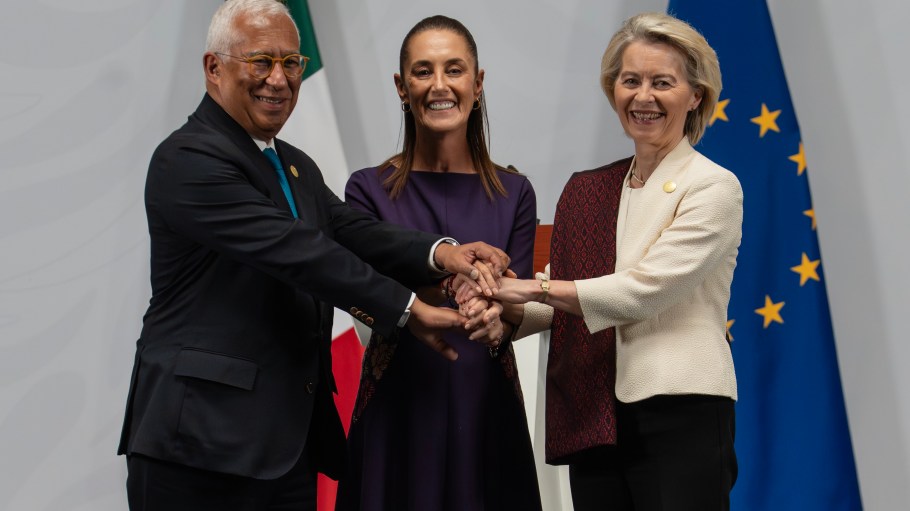
Mexico’s President Claudia Sheinbaum, European Commission President Ursula von der Leyen and European Council President Antonio Costa signed the deal at the EU-Mexico summit in Mexico City, the first such meeting between the two sides in over a decade.
Related Stories
The European Commission first proposed legislation for the agreement in September 2025, with the deal set to remove 95 percent of tariffs on exported goods such as EU dairy and meat, which in many cases saw duties of up to 45 percent. The agreement also eliminates export restrictions and import duties on raw materials, while prohibiting export monopolies and banning dual pricing on these inputs, to help secure the bloc’s access to critical minerals.
Under the new deal, the EU will access new markets for products, such as agri-food like pork, dairy, cereals, fruit and pasta, as well as pharmaceuticals and machinery. Conversely, the pact will bring more Mexican exports such as coffee, fruit and chocolate into European countries.
“At a time marked by increasing turbulence and profound transformations, we have chosen to expand, deepen and update the bonds of our strategic partnership, drawing on our shared history, values and commitment to multilateralism and the rules-based international order,” EU and Mexico representatives said in a statement.
Speaking at a press conference on Thursday, EU foreign policy chief Kaja Kallas said that the bloc is Mexico’s third-largest trading partner and that trade between the two regions has grown by 75 percent over the past decade.
Mexico’s economy ministry estimates the new agreement could increase Mexican exports to the EU from around $24 billion a year to $36 billion by 2030. The EU exports around $65 billion in goods annually to Mexico.
With the deal in place, Mexico and the EU will now set their sights on their largest trade partner, the U.S.
The Office of the United States Trade Representative (USTR) announced Wednesday that the U.S. and Mexico will hold a series of bilateral negotiating rounds to discuss the first joint review of the USMCA.
On Thursday and Friday, deputy USTR Ambassador Jeff Goettman will lead a U.S. delegation to Mexico City for the first round, which will feature negotiations on economic security and rules of origin for certain industrial goods.
A second round of talks will take place in Washington, D.C. on June 16-17, which will include discussions on agriculture. Representatives will return to Mexico City for a third negotiating round on July 20.
USTR Ambassador Jamieson Greer said at a Council on Foreign Relations event on Tuesday that the U.S. plans to keep tariffs on both Mexico and Canada, indicating they would have duties in place “as long as we have a giant trade deficit.” According to Greer, the U.S. trade deficit with its two North American partners has decreased by 24 percent since April 2025.
Canada is not joining the negotiation in Mexico, with Greer saying the U.S. has some “significant” trade challenges with its northern neighbor.
Prime Minister Mark Carney previously said in April that he did not expect progress to be made in negotiations until the U.S. begins to ease some of the tariffs levied against the country on goods like steel, aluminum, automobiles and lumber. These tariffs are as high as 50 percent. Like Mexico, Canada has sought to diversify its trade partnerships, setting a goal to double its non-U.S. exports by 2035.
As Mexico looks to sort out its part of the USMCA, EU representatives await a ratification vote next month that would affirm the terms of its looming trade pact with the U.S.
Lawmakers in the 27-member bloc struck a compromise last week implementing 15 percent tariffs on EU goods stemming from the deal initially struck last July.
On Wednesday, EU member governments cleared the legislation required to remove the import duties on the U.S.-originated goods. The compromise included safeguards that that would make these tariff cuts conditional on the U.S. implementing its side of the agreement.