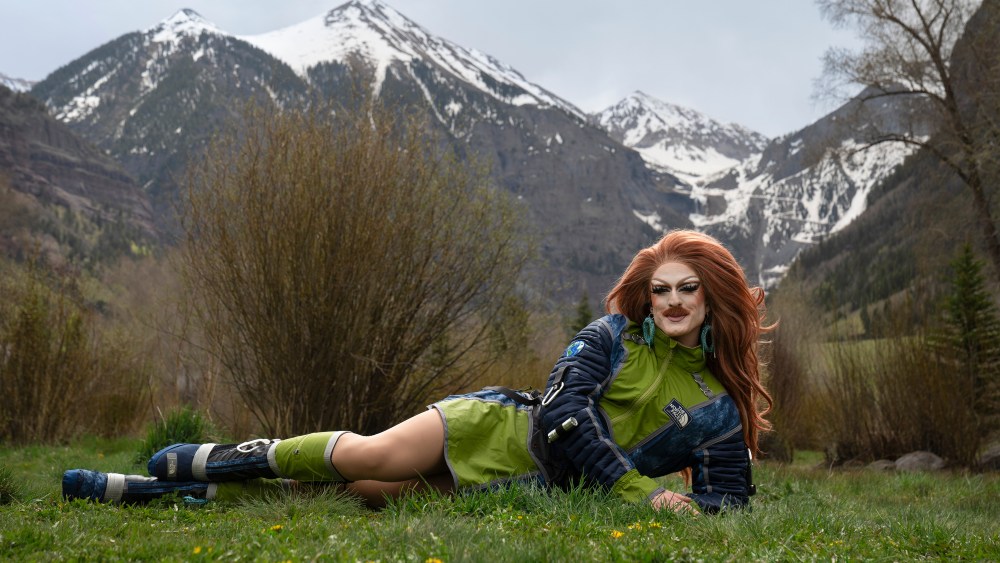
The drag performer and climate activist “Pattie Gonia” went public about their legal battle with Patagonia over trademark infringement via social media on Wednesday. Disputing the company’s claim that the suit is for $1, Pattie Gonia claimed to be facing millions of dollars in legal fees. “This is not a brand conflict. This is a corporation trying to erase an activist,” they said. “If they’re in business to save the planet, why are they suing a climate activist?”
The 37-page complaint was filed by Patagonia in January in U.S. District Court for the Central District of California over trademark infringement, dilution and unfair competition, and calls for a juried trial. It includes images that Patagonia claims shows how Pattie Gonia “integrates Patagonia’s logo and branding into the Pattie Gonia persona and related businesses.”
In a statement issued by a Patagonia spokesperson Thursday, the company said, “This matter is not about seeking financial gain, nor is it about challenging anyone’s identity or right to advocacy, protest, or creative expression. The last thing we wanted was a legal fight with someone who shares our values, but we must protect our business and employees.”
Related Articles
Founded in 1973 by Yvon Chouinard, the outdoors-oriented brand caters to hikers, kayakers and athletic consumers. In 2022, he, his wife and two adult children transferred their ownership of the company, which was valued at $3 billion into a private trust and nonprofit to protect the company’s independence and to fight climate change and preserve protected lands. As of November of last year, Patagonia had annual sales of $1.47 billion and had spent $180 million on conservation and climate change since 2022.
The activist did not respond to a media request immediately Thursday morning. Via TikTok, Pattie Gonia claimed the brand claimed irreparable harm to the brand in its filing in federal court in January, but said its logo and font have never been used on any of Pattie Gonia’s e-commerce merchandise. The activist claimed that while collaborating with an unnamed third party in 2022, Patagonia asked that certain terms be followed and they allegedly had. In addition, the activist’s trademark application was filed “not to compete with a multibillion-dollar corporation” but to avoid losing the name as a fellow drag performer “Lexie Love” had after appearing on “RuPaul’s Drag Race.”
Encouraging a “call to action,” Pattie Gonia, whose given name is Wyn Wiley, said in their social media post, “Patagonia drop the lawsuit.”
Explaining how they had put on a pair of high heels during a backpacking trip in 2018 to create their persona, Patti Gonia said the name referenced the more than 500-year-old region in South America. With a community of three million people, the activist highlighted having launched nonprofit teaching program in the outdoors, hired 600-plus artists and toured drag shows to air climate solutions. “Together we have raised more than $3.7 million for nonprofits,” Pattie Gonia said.
Starting in 2020, Pattie Gonia teamed up with the BIPOC and queer organization Eastern Sierra Conservation Corps to launch an annual Queer Outdoor Expedition for select scholarship winners. That organization along with Brave Trails and The Children’s Home Project are among the nonprofits that the activist has supported. Others know Pattie Gonia for their 2023 collaboration with the cellist Yo-Yo Ma and Quinn Christopherson for the song “Won’t Give Up,” which was meant to be a reminder to not give up on nature or each other.
You May Also Like
Patagonia stated that over the past several years, it had “tried to find a path forward that would allow Pattie Gonia to continue their work while also protecting the Patagonia trademark.” Those talks included “multiple proposals, ongoing dialogue and genuine efforts to avoid this ending up in court. Unfortunately, we could not reach an agreement,” the statement read.
Asked about the lawsuit on Thursday, Stanford University Law School professor Mark Lemley said, “I think Patagonia can’t — and shouldn’t be able to — stop Patti Gonia from using the name in her performances. It is a parody, and no one is likely to be confused. But Pattie Gonia may have a harder time defending her sale of Patti Gonia T-shirts and other merchandise that is much closer to Patagonia’s core market.”

Sewbranded founder Scott Woodward agreed, saying that he was empathetic to Wiley’s request to drop the trademark infringement lawsuit, but he “fully understands the brand’s concern about confusion, dilution and trademark protection as Patagonia’s spelled and phonetic trademark is one of the most revered, respected and valued in the brand world.”
Woodward pointed to previous disputes that other drag performers Brita Filter, Jan Sport, Juicy Kutoure and Calvin Clean each had with their respective similarly named brands. “It’s not new territory, but nonetheless still considerably damaging to those brands causing confusion in media materials, and potentially diluting the brand’s cache in the marketplace,” he said.
Alexandra Roberts, faculty director for Northeastern University’s School of Law’s Center for Law, Information & Creativity, noted that Patagonia is not seeking to get Pattie Gonia to relinquish her stage name, but “only to avoid any commercial use of her name that creates a likelihood of confusion or dilution.”
From Roberts’ standpoint, Pattie Gonia’s name and use of it with “goods and services are different enough from the Patagonia marks to avoid either confusion or dilution by blurring. But reasonable consumers might differ on that,” she said.
Suggesting the “supposed ‘duty to police’ in trademark law is often overblown, Roberts said, “Brands like to act, as Patagonia does here, as though they’re obligated to enforce their marks aggressively because, if they don’t come after every person or company using anything remotely similar, they’ll lose their rights altogether. But that’s not really a reflection of the case law.”
Patagonia closed its statement with, “Patagonia has a responsibility to protect the company that generations of employees have helped build. Not because a name matters more than people, but because that name carries trust, purpose, and decades of work connected to environmental activism, product, storytelling and community impact. Protecting the Patagonia trademark is part of protecting the ability of this company to continue doing that work in the future.”
“Not surprised Patagonia is taking this seriously,” Woodward said the company aims “to establish legal boundaries to protect its brand identity, while also avoiding severe financial penalties for the activist, despite the reliance on pun, parody and spelling. Having it spelled differently, but pronounced the same by a performer is understandably concerning for them and even confusing for the marketplace.”