
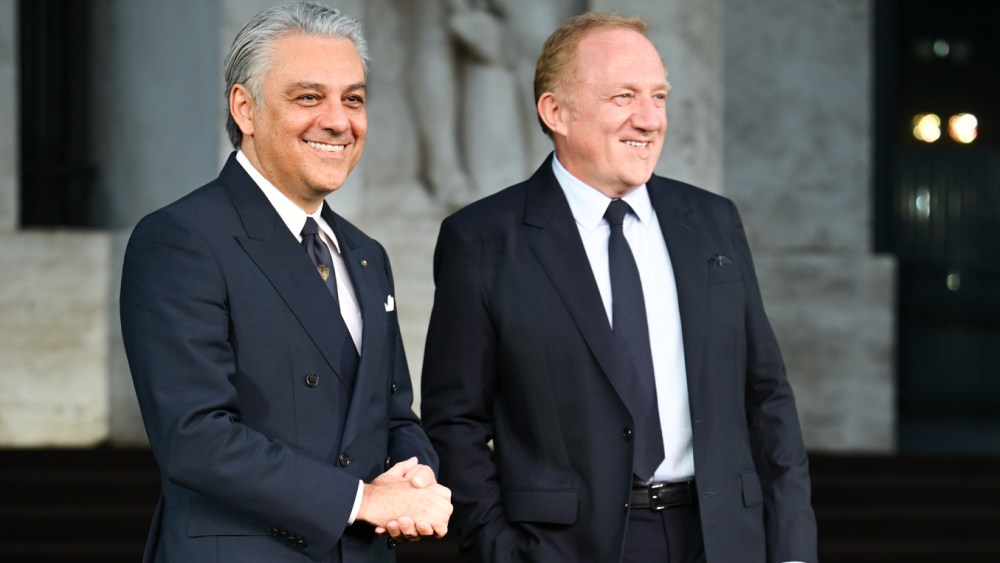
Are selfies with big European luxury executives the latest social media flex?
At Kering‘s annual general meeting on Thursday in Paris, so many shareholders requested a photo with chairman François-Henri Pinault he joked that possessing a single share would only earn a photo with chief executive officer Luca de Meo, whereas two would be required for him.
The nearly three-hour meeting was an opportunity for de Meo to deliver a Cliff Notes version of the 360-degree strategic road map he unveiled at Kering’s Capital Markets Day in Florence last month, displaying his simplified organizational chart and his flair for public speaking.
Related Articles
The Italian executive, who joined Kering last September after a long career in the automotive industry, expressed his confidence in the group’s potential, arguing that it is the player best suited to “future luxury” given its streamlined organization, agility and “challenger” mindset.
You May Also Like
He remains bullish on the jewelry segment, and in the turnaround efforts at Gucci, led by creative director Demna and CEO Francesca Bellettini.
The executive reiterated ambitions to renovate more than two-thirds of Gucci’s store network, noting layouts would be reconfigured to reflect a simplified product offer, better transmit brand codes, and accommodate secure departments for fine jewelry, among categories he aims to leverage at the ailing Italian house.
He touted jewelry as resilient, strongly emotional, and under-exploited by the group, which owns Boucheron, Pomellato, DoDo and Qeelin.
Veteran Chanel executive Marie-Hélène Chenut and Laurent Kleitman, group CEO and director of the Mandarin Oriental hospitality group, were invited to state their case before being voted in as independent directors.
Kleitman’s addition to the board of directors prompted questions whether Kering might be eyeing branded hotels for their star brands Gucci and Saint Laurent.
De Meo poured cold water on that speculation, arguing that there are business segments offering higher growth potential and profitability, such as wellness and longevity, which Kering has said it plans to explore with L’Oréal via a joint venture, part of its 4 billion-euro deal with the French beauty giant.
The meeting was light on new financial indicators, though de Meo reiterated his ambition to more than double profitability by 2030.
Between 2022 and 2025, Kering’s recurring operating margin tumbled from 27 percent to 11 percent as its main growth engines — Gucci and China — stalled.
De Meo noted that new executive compensation structures are linked to brand desirability measures, and the group’s stock market performance, among other factors.
The former Renault Group honcho acknowledged that he facilitated the deal unveiled earlier this week that saw Gucci sign on as title partner of the Alpine Formula 1 Team, which beginning with the 2027 season will compete in Gucci colors under the banner Gucci Racing Alpine Formula 1 Team. (Alpine is owned by Renault.)
De Meo also fielded a question about Kering Eyewear’s ambitions with connected glasses in partnership with Google, and touted that the group’s key advantage is the wide variety of designs it produces under such diverse names as Maui Jim, Lindberg, Gucci, Balenciaga, Valentino and Puma.
Earlier this month, a shareholder at LVMH’s annual general meeting asked luxury titan Bernard Arnault if he would pose for a selfie, which may have set off the trend.